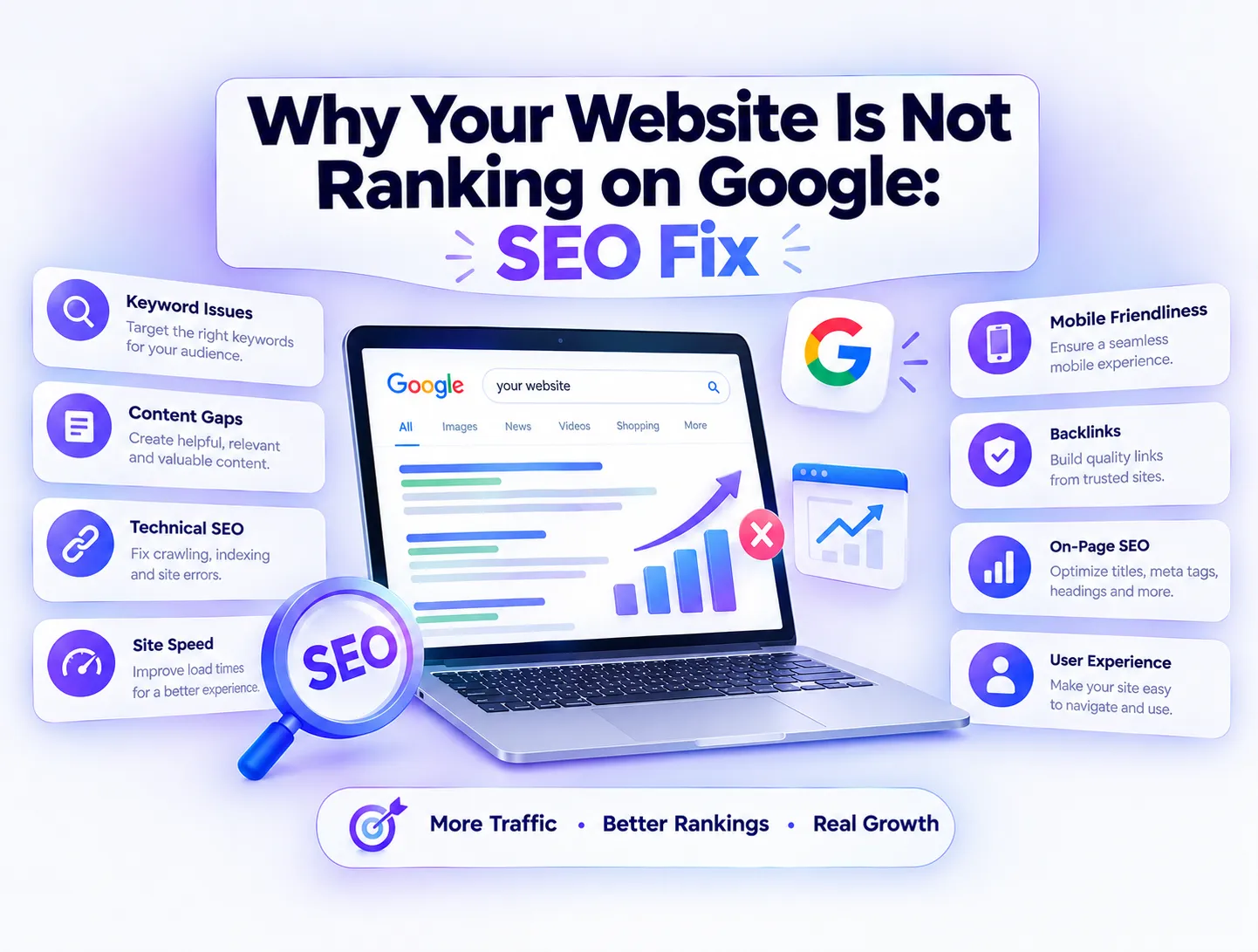
Why Your Website Is Not Ranking on Google: SEO Fix
Struggling to secure visible positioning on major search engine results pages can severely restrict digital growth, reduce inbound lead generation, and limit overall brand reach. When organic search impressions stall unexpectedly, identifying the exact underlying technical or structural bottlenecks becomes a critical priority for business owners and digital strategists. Solving organic search indexation issues requires a rigorous examination of technical site performance, crawl efficiency, user engagement signals, and on-page optimization standards. Aligning your digital platform with current search engine evaluation guidelines through professional on-page SEO services establishes a reliable foundation for restoring keyword visibility, accelerating domain authority, and capturing high-intent search traffic.
1. Resolving Critical Google Indexation and Crawlability Issues
Before any web page can achieve top keyword positioning, search engine crawlers must be able to discover, crawl, and store its content within their primary indexing databases without encountering technical barriers. Accidental configuration errors within your robots.txt file, misconfigured meta tags, or improperly applied canonical URLs can silently block search engine bots from evaluating your most important landing pages. Conducting routine diagnostic audits through Google Search Console allows webmasters to catch indexing anomalies early, resolve HTTP status code errors, and ensure critical page assets remain completely accessible to automated search crawlers.
2. Eliminating Thin Content and Satisfying Searcher Intent
Modern search engine algorithms prioritize comprehensive, highly informative content assets that deliver clear, direct answers to consumer queries over shallow or repetitive text blocks. Publishing low-value or duplicated content fails to demonstrate genuine topical authority, causing search crawlers to deprioritize your domain during competitive ranking evaluations. Rebuilding underperforming web pages around detailed, user-focused explanations ensures your content thoroughly answers consumer intent, increases average time on site, and fulfills quality evaluation standards needed for higher organic placement.
3. Optimizing On-Page Metadata and Structured Schema Markup
Incomplete title tags, missing meta descriptions, and disorganized heading hierarchies confuse search engine bots about the primary topical focus of your web pages. Crafting concise, keyword-rich header structures combined with high-CTR meta tags provides clear structural context that helps search algorithms categorize your content accurately. Furthermore, embedding structured JSON-LD schema markup gives search engine crawlers explicit data regarding your business entities, service offerings, and content relationships, increasing eligibility for prominent rich snippets in search results.
4. Overcoming Slow Page Speed and Core Web Vitals Bottlenecks
Page loading speeds and overall interface responsiveness play a direct role in determining organic search placement and user retention rates across mobile and desktop environments. Web pages that suffer from delayed rendering times, sluggish interaction responses, or sudden layout shifts create frustrating user experiences that drive visitors to return immediately to search results. Streamlining unoptimized JavaScript, compressing visual image assets, and utilizing modern browser caching frameworks ensures your website meets strict Core Web Vitals metrics, lowering bounce rates and protecting keyword rankings.
5. Restructuring Weak Internal Link Architecture and Page Rank Flow
An disorganized internal linking structure prevents search engine crawlers from passing PageRank authority efficiently across your digital platform, leaving valuable secondary landing pages orphaned and unindexed. Establishing logical content clusters backed by descriptive, keyword-targeted anchor texts allows search algorithms to discover deep pages effortlessly while understanding contextual topic hierarchies. Strengthening internal link flows across related blog posts and core service hubs ensures high-value landing pages receive the internal authority necessary to rank competitively for broad industry search phrases.
SEO Ranking Diagnosis and Action Plan Matrix
| Issue Category | Primary Symptom in Search Console | Root Technical Cause | Recommended SEO Fix |
|---|---|---|---|
| Indexation Blocker | "Discovered - currently not indexed" | Crawl budget limits or low page quality | Improve content depth and fix internal linking |
| Technical Error | "Excluded by noindex tag" | Accidental meta tag configuration | Remove noindex directives from target URLs |
| Search Intent Mismatch | High impressions but ultra-low CTR | Irrelevant title tags or weak meta copy | Rewrite titles to match exact search intent |
| Performance Issue | Failed Core Web Vitals in field report | Uncompressed images and heavy scripts | Optimize code assets and enforce server caching |
| Authority Deficit | Stuck on search pages 3 or 4 | Lack of external links and topical depth | Build contextual backlinks and content clusters |
6. Building External Backlink Authority and Topical Trust
Even perfectly optimized web pages can struggle to break onto the first page of search results if the parent domain lacks sufficient overall backlink authority and trust. Search engine algorithms view editorially earned backlinks from established industry publications as independent votes of confidence regarding your site legitimacy. Focusing on acquiring authoritative external link citations while publishing consistent, interconnected content hubs reinforces domain trust, making it significantly easier for new landing pages to secure competitive rankings rapidly.
7. Fixing Mobile Usability Errors and Responsive Layout Issues
With search engines evaluating digital platforms primarily through mobile-first indexing standards, any display or usability failure on mobile viewports negatively impacts desktop rankings as well. Unclickable touch elements, text blocks that extend beyond screen boundaries, or slow mobile network execution signal poor overall technical design to search bots. Ensuring fully responsive layouts, readable typography, and seamless touch navigation guarantees your platform satisfies Google mobile quality criteria across all consumer devices.
8. Aligning Traffic Recovery with Google AdSense Optimization
Restoring lost search engine traffic directly influences online publisher revenue models, user engagement metrics, and overall ad inventory viewability. When organic visitors land on fast, highly relevant pages that deliver immediate value, session durations increase and bounce rates drop significantly. Maintaining clean, ad-friendly page layouts that balance content visibility with non-intrusive ad placements protects publisher account compliance while maximizing ad interaction rates and overall RPM metrics.
9. Monitoring Search Console Reports and Position Fluctuations
Diagnosing ranking declines requires continuous monitoring of organic performance metrics within Search Console and analytics dashboards rather than relying on periodic manual searches. Tracking click-through rate trends, average keyword positioning shifts, and impression volumes allows webmasters to isolate performance drops to specific URL clusters or algorithm updates. Proactively updating stale content assets, repairing broken links, and optimizing underperforming pages maintains organic momentum and protects valuable search real estate over time.
10. Sustainable Technical SEO Execution for Long-Term Growth
Achieving stable, long-term search engine rankings requires a continuous operational commitment to technical health, content quality, and modern web standards. As search algorithms evolve to emphasize real-world user experience and structured data, maintaining a clean, high-performance infrastructure becomes essential. Collaborating with technical specialists at Webnestech equips your digital business with fast loading speeds, clean code architecture, and sustainable search engine visibility that drives reliable, long-term commercial growth.
Frequently Asked Questions
Essential diagnostic questions regarding why web pages fail to rank on Google and how to fix them.
After fixing indexation or on-page SEO issues and submitting URLs in Google Search Console, ranking improvements typically take between 2 to 6 weeks depending on domain authority.
Indexation merely means Google knows your page exists; page 1 rankings require high content relevance, strong topical depth, good user signals, and backlink authority.
Yes, duplicate content causes keyword cannibalization and confuses search bots about which URL to index, resulting in suppressed search visibility across all duplicates.
Log into Google Search Console and inspect the "Manual Actions" tab under the Security & Manual Actions section to see if any penalty notices exist.
Slow loading speeds increase user bounce rates and fail Google Core Web Vitals checks, which acts as a direct negative ranking signal in competitive niches.
Struggling to rank your website on Google?
Our technical SEO development team is here to audit and fix your search engine visibility.