
Top Web Development Trends to Watch in 2026
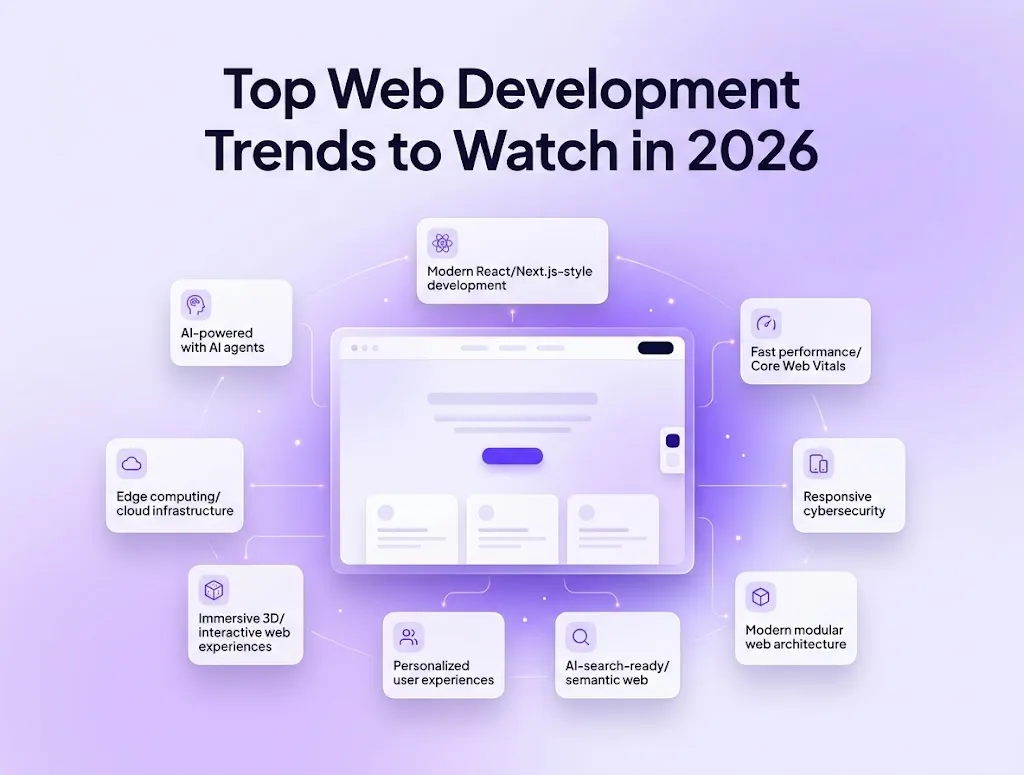
These are the most prominent web development trends that you should be looking forward to in 2026. The following are the top web development trends for 2026.
The pace at which Web development is evolving is increasing at a tremendous pace. In 2026, companies are no more looking for a beautiful website. Today's websites must be quick, secure, accessible, mobile-ready, intelligent and provide personalisation.
Artificial intelligence is becoming an integral part of the development cycle; edge computing is changing the way websites and web applications are built; server-first approaches are affecting the website and web application development process; WebAssembly is changing the way websites and web applications are built; and modern CSS is changing the web interface.
For developers, business owners, startups or individuals looking for planning a new website, it will be easier to make technology decisions if they have an understanding of these trends.
1. AI-Powered Web Development
AI will be one of the most noticeable trends in web development in 2026.
Developers turn to AI tools to create code, write tests, highlight bugs, clarify code they don't know, develop components and automate repetitive development work. AI has gone beyond the basic predictive list of suggestions to more agentic uses of AI tools to complete a range of development tasks with less agent involvement.
But the role of developers is not going away as a result of AI.
Human review, testing, security review and architecture are required for generated code. The best developers will be a game-changer with AI, because they're already familiar with the basics of programming and capable of evaluating the AI solutions.
In 2026, knowing how to use AI will be the key skill, and so will be being able to use it well. It's about the effective use of AI, but maintaining code quality and security.
Chatbots and Customer Support Automation
Data Privacy and Security
AI is also penetrating web pages.
Server-based AI algorithms can provide users with personalized recommendations and search results, product suggestions, content, and even customer support, all tailored to the individual user's needs.
AI can be used to recommend products to e-commerce companies according to customer information. For service businesses, intelligent chat systems can help answer frequently asked questions and guide visitors to the appropriate services.
This indicates that websites are increasingly becoming more user-friendly and interactive.
2. Agentic User Interfaces
The second new trend is the development of websites that operate in conjunction with AI agents.
When an AI interface can direct the user to complete a task with instructions in natural language, as opposed to having to go through several pages.
For instance, if a customer wants to look for dozens of products they may state:
“Can you get me a computer on which I can edit videos and it has to be less than $1000.”
The website might understand the request and narrow down products, compare specifications, and recommend products.
This is a change from the traditional page-based approach towards task-based digital experiences. Agentic interfaces are emerging as one of the key trends in web development for 2026.
3. Server-First Web Development
The Web today is trending towards server-first solutions with the introduction of new technologies.
Frameworks and architectures that generate more code on server side can lessen the amount of unnecessary JavaScript to be sent to the browser. This can boost the loading performance and also make applications a lot more effective.
It's a component of the broader shift towards React Server Components and the new full-stack frameworks.
It's not all about the latest framework.
It will pass on useful information quickly, and only pass the needed JavaScript to the browser.
4. Edge Computing
Edge computing is a big issue today in the Web applications world.
Typical applications are those that process requests in a central server. Edge computing brings some processing nearer to the users.
This can help decrease latency, especially for websites that cater to users in varied geographic areas.
Fast responses are being required in growing numbers of applications, and are considering edge architectures. But they also add to the complexity of running your business, and should only be used if they have an actual performance or scaling advantage.
5. Usefulness of WebAssembly Grows
With WebAssembly (or Wasm), developers can deploy high performance code in the web environment.
This is especially helpful for those that require challenging calculations.
Examples include:
- Video editing
- 3D applications
- Games
- Image processing
- Engineering software
- Data visualization
- Scientific applications
Wasm will be used to allow performance-critical components built in Rust and other languages, such as C++, to be included in web applications.
But it's not required on all websites. Its greatest use seems to be where JavaScript is not the appropriate language choice for heavy computation tasks.
6. Modern CSS Is Making It Easier to Lessen the Reliance on JavaScript
The more that CSS improves, the more it improves.
Now the developers can create more complex layouts and interactions, with the help of modern CSS features, instead of huge JavaScript libraries for every visual effect.
The technologies that are catching attention in the modern web development are: Container queries, CSS nesting, modern layout systems and scroll-driven animations.
This can result in more efficient code and quicker performance when used correctly.
The lesson for the developers is that:
If possible, don't reach for JavaScript, try and solve the problem with modern CSS first.
7. It's Essential to Start with a Mobile-First Design
While mobile-first development is not a new concept, it is still a very significant issue in 2026.
Users of mobile devices expect websites to perform seamlessly on their mobile devices.
A modern website should provide:
- Responsive layouts
- Fast loading
- Easy navigation
- Touch-friendly buttons
- Readable text
- Optimized images
- Simple forms
Websites should be tested on real mobile devices and not rely on responsive mode as this does not necessarily reflect the full picture on a desktop browser.
8. Progressive Web Applications
PWA is an interesting hybrid of website and app, but what happens to it is still up for debate.
PWAs can provide app-like experiences using web technologies – capabilities include installation and offline functionality, depending on the browser and implementation.
These can be beneficial when a business would like a quality experience for its application, but can't handle the idea of having two entirely different code bases.
But developers should consider if adding all of the features of PWA are necessary to address a user problem or adding too much complexity.
9. Composing Architecture Without Head
Headless development is the division of the front end user experience from the back end system.
For example, an ecommerce business could use one technology for managing a product and another for creating its website.
This provides teams with more flexibility.
A company could be linked:
- Headless CMS
- Ecommerce platform
- Custom frontend
- Payment system
- CRM
- Search platform
- Marketing tools
It can be a very effective way to work in large organisations, but can also be technically complicated.
However, the simple architecture might be more suitable for smaller businesses.
10. Web Security
With each passing year, Web Security grows more important.
The more intelligent and linked-up a website is, the more important security becomes.
The developer should take into account:
- Authentication
- Authorization
- API security
- Data protection
- Dependency vulnerabilities
- Supply-chain security
- Secure deployment
- AI-related risks
Security should not be added as an add-on.
This should begin from an early stage in the development.
The adoption of new security ideas, such as DevSecOps and software supply-chain controls, is growing due to the increasing significance of security in developing professional Web apps.
11. Accessibility by Design
Making a site accessible is a current trend in developing a professional site.
Websites should be usable by people with diverse abilities and should be easy to navigate, easy to read, accessible on the keyboard, have labels and offer adequate support for interacting with the website.
Compliance is not the only aspect of accessibility.
It also renders it more user-friendly for everyone.
An accessible, well organized site will likely be easier to navigate, maintain and understand.
12. Enhanced for Improved Core Web Vitals and Performance
Users don't want to have to wait for websites to load.
Performance is still very important to both users as well as search engines.
As a result, developers are now turning their attention to:
- Loading speed
- Interaction responsiveness
- Layout stability
- Image optimization
- JavaScript execution
- Server response time
There is no longer a focus on achieving a good lab score, but on creating the most realistic experiences for real users.
13. AI-Assisted Testing & Debugging
AI is also proving to be helpful in testing.
AI tools can assist developers in creating test cases, detecting potential bugs, providing explanations of errors, and code review.
This can help to reduce recap work and help teams to identify the problems earlier.
Automated testing should not be used as an alternative to human testing.
Production software is still required to be tested carefully with regards to the business need, however.
14. A Vast Improvement of Web Apps
The difference between websites and applications continues to become less obvious.
Advanced experiences today's browsers can provide with:
- Real-time collaboration
- Video
- Audio
- 3D graphics
- Advanced data processing
- AI features
- Offline functionality
- Desktop-like interfaces
The Web's more sophisticated features can make possible a software that was previously only available for desktop computers to be made available online.
Final Thoughts
There's no single framework or programming language that's the top Web development trend in 2026.
It's the gradual trend towards smarter, faster, more customized, secure and efficient web experience.
The way AI is used in developer work has evolved. With edge computing the place of apps is changing. WebAssembly is expanding the functionality of browsers. New CSS is minimizing needless JavaScript. While usability and security are now critical features and not optional extras, performance is really on the server first architectures.
But businesses should not follow trends, as they must be able to determine which ones work for them and which ones don't.
The best choice is to choose the technology that is required.
A small business may need a website that is easy to find, optimised for search engines and is very simple.
A full-stack application might be the need for a SaaS business.
The enterprise can benefit from any of these: Edge infrastructure, headless architecture, AI agents, and advanced security.
Creating the latest cool site is less important for successful website development in 2026, it's more about creating the most appropriate site for the problem.
Future web is intelligent, performance-driven, accessible and soon to be automated; companies that build with these attributes will be prepared for the future.