Introduction to Topical Authority and Semantic SEO
Search engine algorithms have evolved far beyond basic keyword density matching. Modern search engines rely heavily on topical authority and semantic SEO to evaluate whether a website possesses genuine expertise across an entire subject area. Rather than ranking isolated pages, search crawlers analyze how your content connects logically across entity relationships, search intent layers, and contextual link graphs. Establishing a deliberate internal linking architecture transforms standalone blog posts into a powerful knowledge hub that search crawlers trust and index rapidly.
Understanding Semantic SEO and Entity Relationships
Semantic SEO is the practice of structuring web content around underlying concepts, subtopics, and entity relationships rather than single focus keywords. When search engines evaluate a query, they analyze the natural language context, user intent, and vector embeddings connecting related concepts. A domain that covers every subtopic, answers long-tail questions, and links those concepts together establishes semantic coverage. This semantic depth signals to search crawlers that your site is a primary source of truth within your industry.
Building a Topic Cluster Architecture
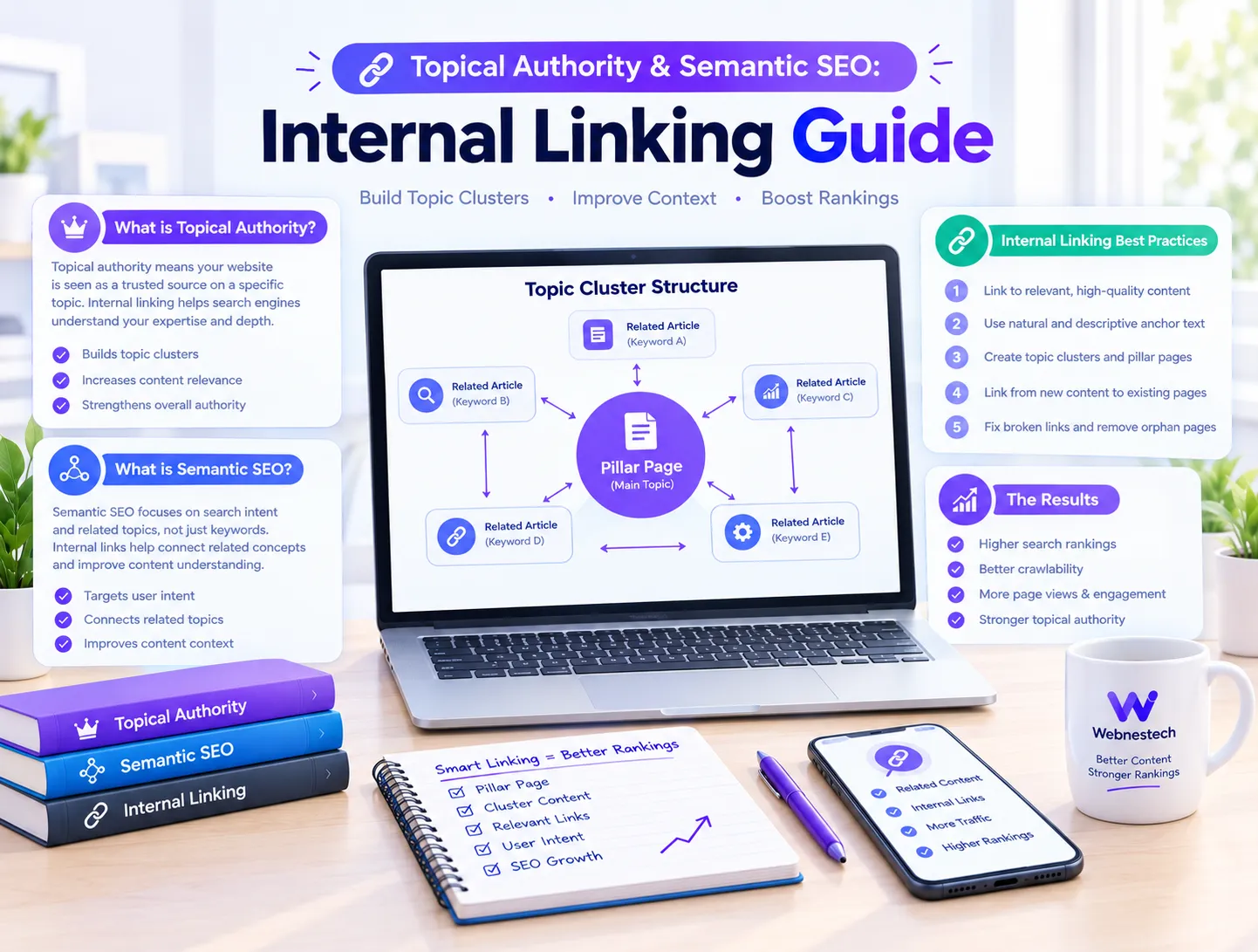
The foundation of topical authority lies in a structured hub-and-spoke model, commonly known as a topic cluster. This architecture consists of three core components:
- Pillar Pages: Broad, high-level guide pages (1,500–2,500+ words) that cover a core subject comprehensively and establish main target entities.
- Cluster Articles: Specialized deep-dive posts that answer specific long-tail queries, technical subtopics, and secondary search intents connected to the main pillar.
- Contextual Internal Links: Bidirectional hyperlinks that pass equity and topical context from cluster articles back to the main pillar, and horizontally across sibling cluster pages.
Internal Linking Architecture and Link Equity Flow
An optimized internal linking strategy serves as the primary distribution network for PageRank, crawl budget, and topical relevance across your domain. Without deliberate internal links, even high-quality articles risk becoming orphaned pages—invisible to search crawlers and deprived of ranking authority. When high-performing pages pass link equity to deeper supporting articles using descriptive anchor text, search engines calculate a higher semantic relevance score for the entire cluster.
Search Engine Optimization Strategy
Aligning your content map with modern search engine guidelines requires a technical and strategic site audit. Implementing professional SEO services helps eliminate crawl bottlenecks, fix orphan pages, and build an authoritative internal link hierarchy that accelerates indexation across competitive search verticals.
Practical Rules for Semantic Anchor Text Optimization
Executing an effective internal linking workflow requires careful attention to anchor text selection and paragraph placement. Follow these core rules to ensure maximum contextual signaling:
- Use Exact and Variant Semantic Terms: Avoid generic anchor phrases like "click here" or "read more". Instead, use descriptive keywords that explicitly name the target topic (e.g., "technical SEO audit" or "on-page optimization").
- Embed Links in Contextual Passages: Place internal links inside body paragraphs where the surrounding 50–100 words discuss related semantic concepts. Search crawlers evaluate surrounding paragraph relevance during passage indexing.
- Establish Upward and Downward Linking Paths: Ensure every supporting cluster article links upward to its canonical parent pillar page and outward to 2–3 sibling articles covering adjacent subtopics.
- Update Legacy Posts (Reverse Interlinking): Whenever you publish a new cluster article, update older, indexed blog posts to link back to the new post. This reverse link flow passes immediate crawl priority to new URLs.
Digital Growth Services
Building a scalable, high-converting digital platform requires pairing technical SEO architecture with robust web design and custom application development. Partnering with an expert digital solutions agency like Webnestech ensures your technical site structure, user experience, and organic search strategies are engineered for sustainable growth.
Topical Authority Framework Comparison Matrix
The following table illustrates the structural differences between traditional, unlinked publishing and an optimized semantic topic cluster architecture:
| Architectural Element | Traditional Flat Publishing | Semantic Topic Cluster Architecture |
|---|---|---|
| Content Organization | Random articles targeted at isolated keywords | Structured pillar pages and connected subtopic spokes |
| Internal Linking Pattern | Generic, missing, or footer-heavy navigation links | Contextual body links passing equity across topics |
| Search Engine Interpretation | Disconnected pages struggling for individual rank | Unified knowledge hub demonstrating topical expertise |
| Crawl Budget Efficiency | High risk of orphan pages and crawler timeouts | Streamlined crawl paths prioritizing new content |
| Indexation Stability | Vulnerable to core quality updates and decay | Durable rankings supported by domain-wide signals |
How Topical Authority Prevents AdSense Low Value Content Errors
A common reason websites suffer from Google AdSense "Low Value Content" rejections is quality dilution—having dozens of thin, unlinked, or unindexed pages in their XML sitemap. Building structured topic clusters eliminates thin content flags by organizing thin utility pages under comprehensive hub resources. When search bots crawl a site with high semantic coverage and zero orphan pages, they evaluate the domain as an authoritative publisher eligible for ad serving.
Step-by-Step Implementation Checklist
Follow this actionable roadmap to audit and deploy a topical authority framework across your website:
- Map Your Core Entities: List your primary services, products, or knowledge areas and group related questions into clear topic buckets.
- Audit Existing Sitemap URLs: Review Google Search Console to identify orphan pages, duplicate topics, or decaying posts that need consolidation.
- Draft Master Pillar Pages: Create or update primary pillar guides that link out to every subtopic in the cluster.
- Execute Contextual Interlinking: Add 3–5 contextual body links within every cluster post targeting parent pillars and sibling articles.
- Verify Search Console Coverage: Ensure that internal linking updates lead to a 85%+ indexation rate for all sitemap URLs in Search Console.
Long-Term Organic Traffic Scaling
Topical authority is a compounding asset. As you continuously publish new supporting articles and connect them back to your main pillar hubs, search engines pass equity across the entire cluster. Maintaining clean internal linking pathways, removing thin pages, and expanding your semantic entity coverage ensures your website achieves top rankings, high indexing velocity, and long-term search performance.
Frequently Asked Questions
Key answers regarding topical authority, semantic SEO, internal linking architecture, and content clusters.
Topical authority measures how comprehensively a website covers a specific subject area through interconnected, high-depth content clusters.
Semantic SEO focuses on entity concepts, subtopic relationships, and user intent rather than repeatedly targeting single focus keywords.
Internal links pass authority (link equity), communicate semantic relationships to search crawlers, and prevent orphaned pages.
A strong topic cluster typically consists of 1 main pillar page connected to 8–15 supporting cluster articles targeting distinct long-tail subtopics.
Yes. Organizing thin or orphaned posts into structured topic clusters demonstrates high editorial standards, helping satisfy AdSense publisher quality policies.
Ready to build topical authority and transform your internal linking architecture?
Work with expert strategists to optimize your technical SEO, content clusters, and search performance.