
Shopify Vs Custom Website - Which is Better for SEO in 2026
Any company considering expansion online is going to need to make an essential decision when it comes to website systems. SEO is more competitive than ever and if you have a slow site, mobile unfriendly, hard to maintain, you can't do a successful content marketing campaign. There are two popular options: Shopify and custom website.
But which one is more beneficial for SEO?
This will depend on the requirements of your business. Custom website will have more control of technical SEO, performance, and functionality, however, Shopify will be easier to set up and manage. With optimized correctly both can rank well on Google.
What Is Shopify?
Shopify is an ecommerce platform which lets you build and run an ecommerce store without building it yourself. It provides you with hosting, security and ecommerce tools, product management, payment integration and a number of SEO tools.
Shopify automatically handles these key technical details, such as XML sitemaps, robots.txt, SSL and canonical tags. The store owners will be able to edit the page titles, meta descriptions, URLs, image alt text and others.
Shopify is a great platform for startup, small and expanding ecommerce enterprise.
But, Shopify cannot ensure rankings. But, there is still need for very good content, keyword research, internal links, back links, optimized product pages and overall good SEO.
What is a “Custom Website?”
The custom web site is created to meet specific requirements of a company. Developers construct the structure, features, appearance and technical requirements of the website, instead of having to use a traditional ecommerce platform.
One of the best features of a custom website is its adaptability.
The URL structure, server configuration, page templates, database, JavaScript, schema markup, redirects, caching and so much more technical aspects are under your control.
It can be particularly beneficial for large enterprises with intricate needs.
But, the more control, the more responsibility. If you're unfamiliar with SEO, then you could have some technical issues with your custom website, which may include crawlability issues, bad internal link structure, duplicate pages, slow loading, and wrong canonical tags.
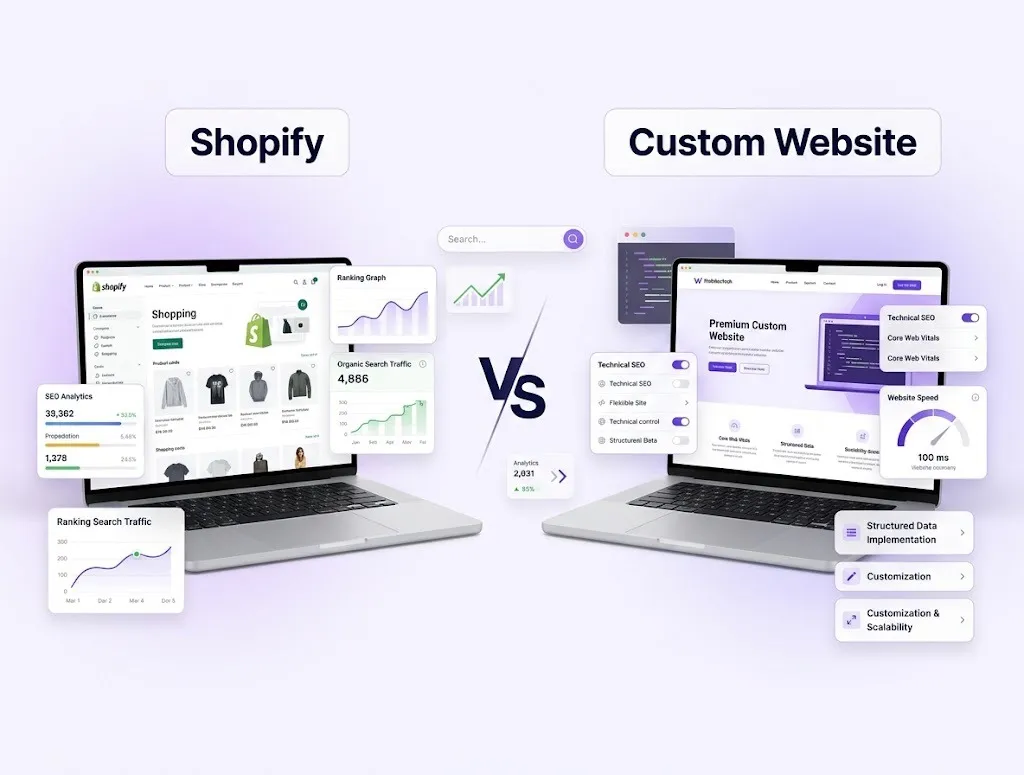
Shopify vs Custom Website for SEO
The verdict of Shopify vs custom website SEO is never a clear cut one.
Shopify is easier to maintain, in general, while custom sites offer more technical flexibility.
Shopify could be better suited if you have a small to medium-sized ecommerce business as you will be able to launch the business in a short time frame and focus on marketing and SEO.
Advanced SEO optimization can be more possible if the enterprise business needs are complicated and they consider their business as custom development.
Technical SEO
The biggest difference between the two, on Shopify or custom-built, is the technical aspect of SEO.
Shopify takes care of numerous technical aspects. This can minimize the chances of novices committing major errors.
They in addition offer a ton more control for developers as they have custom website. They can optimize the server, database, code, caching, rendering, redirections and page architecture.
This flexibility, however, can be a really big good thing – provided the development team makes use of it right.
As far as technical is concerned, custom websites are going to deliver a much better SEO, and, Shopify can be much easier to operate successfully.
Website Speed
Your website's speed is important to your users and the search engines.
This is a great misconception because all the custom websites are not necessarily faster than Shopify websites. That is not true.
A slow web site can be caused by a poorly coded site, or a poor quality host, but a good quality custom site will be fast.
Conversely, adopting a light theme, optimizing images and utilizing just a handful of unnecessary applications can boost a Shopify store to run more effectively.
Adding too many third-party applications, tracking scripts, popups and other resources to Shopify stores can cause them to become slower.
That's important, but it's much more important to implement.
On-Page SEO
Whether you are an Shopify or custom website, you can use on page optimization (SEO).
Important elements include:
- SEO-friendly titles
- Meta descriptions
- H1 and H2 headings
- Optimized URLs
- Product descriptions
- Image alt text
- Internal links
- Relevant keywords
- Helpful content
A number of them can be quickly customized within the Shopify admin panel.
A custom made website can be even more flexible because it is feasible to create custom templates and SEO solutions.
For instance, if you're a large ecommerce retailer, you might need thousands of product pages, each having automatically-generated content. Highly specialized automation can be achieved with custom development for this purpose.
All AI-generated articles need to be checked for quality, though. If you have thousands of low quality pages, it will not be beneficial to your SEO efforts.
Content Marketing
This is because in 2026, content is one of the most important elements of SEO.
Sites should not only concentrate on product pages. They should also come up with content that is helpful and responds to customer questions.
As an example, if you have a laptop business, you can write articles such as:
- Best laptops for students
- When buying a Laptop for your child, take into account the following:
- Laptop vs desktop – which is superior?
- What is the amount of RAM required to play games?
These articles can attract users that aren't ready to buy.
Blogging can be done on Shopify or any other custom website constructed on basically any content management system.
So, both can be employed as a successful content strategy.
Ecommerce SEO
Shopify has a huge benefit for ecommerce businesses as ecommerce functionality is already integrated with the platform.
You can create:
- Products
- Collections
- Categories
- Discounts
- Checkout pages
- Product variants
- Payment options
Many of these may be created or incorporated into a custom ecommerce site, but developers will need to create or incorporate numerous of these systems.
Shopify can save a lot of time and development costs if you are looking to sell products online, and don't require something special.
The advantages of Custom Website SEO
A custom website is more favorable if you want to have more control.
Some advantages include:
- Complete URL flexibility
- Custom technical architecture
- Advanced schema implementation
- Greater server control
- Custom database optimization
- Advanced caching
- Custom functionality
- Flexible international SEO
- An extremely flexible page template.
It can be a significant benefit for businesses with complex websites, particularly big companies.
Shopify SEO Advantages
There are also a number of SEO benefits to Shopify.
It is:
- Easy to use
- Fast to launch
- Ecommerce-focused
- Secure
- Scalable
- Beginner-friendly
- There are plenty of integrations that can be used to support it.
It also decreases the amount of technical upkeep that business owners should do.
This will give the marketing team members more time to spend on content, products, customers and growth, and less time on server administration.
Summary Comparison Table
| Feature / Factor | Shopify | Custom Website |
|---|---|---|
| Ease of Setup & Maintenance | Extremely high (Hosted & Managed) | Requires developers & server admin |
| Technical Control | Standardized (Sitemaps, Robots.txt handled) | Complete root & architecture control |
| Speed & Performance | Fast with optimized light themes | Highly customizable based on hosting/code |
| Best Suited For | Small to Medium Ecommerce Stores | Large Scale & Complex Enterprise Portals |
Final Verdict
Thus is it better for SEO in 2026 to be on Shopify or a custom-built website? So which one will prove to be better and more effective when it comes to SEO in 2026 – Shopify or Custom Website?
If you're a small to medium size eCommerce business, then Shopify is the option for you. It has lots of technical value, is easy to use and allows businesses to focus on content and marketing.
If a company requires more technical control, special functionality or a very special structure for the purpose of search engine optimization, then a custom website is even better.
It's important to reiterate here that it doesn't matter whether your website has been built using Shopify or any other method; the website won't automatically rank higher in Google's search results.
The bottom line is that a site that's fast, useful, well organised, has good internal links, is linked by relevant sites and makes for a great user experience will work on either platform.
Ultimately, the platform isn't that important, it's what you do on it.
Opt for Shopify, the easy and efficient choice for building an online store with our Shopify design services.
Think in terms of custom development for greater flexibility and control. Explore our custom development solutions to build a website tailored to your business needs.
The most successful way to do SEO in 2026 is not to employ the newest and coolest technology. It's about creating the most useful, accessible, trustworthy, and optimized website for your target audience.
Frequently Asked Questions
A few things people usually ask about Shopify vs custom website SEO.
No, neither platform guarantees higher rankings by default. Shopify simplifies technical setup like sitemaps and SSL, while custom websites offer complete architectural flexibility.
Speed depends on optimization. A well-coded custom site on a quality host can be extremely fast, whereas Shopify stores can slow down if bloated with too many third-party apps.
Yes, both Shopify and custom-built CMS architectures support robust blogging and content marketing strategies to capture organic traffic.
Large enterprises with hundreds of thousands of products, complex multi-region setups, and bespoke database logic benefit significantly from custom development control.
Google AdSense evaluates content depth, navigation, and user experience rather than the underlying platform. Providing high-value guides on either system satisfies quality guidelines.
Need expert help choosing or building your platform?
Our development team is ready to assist you.