

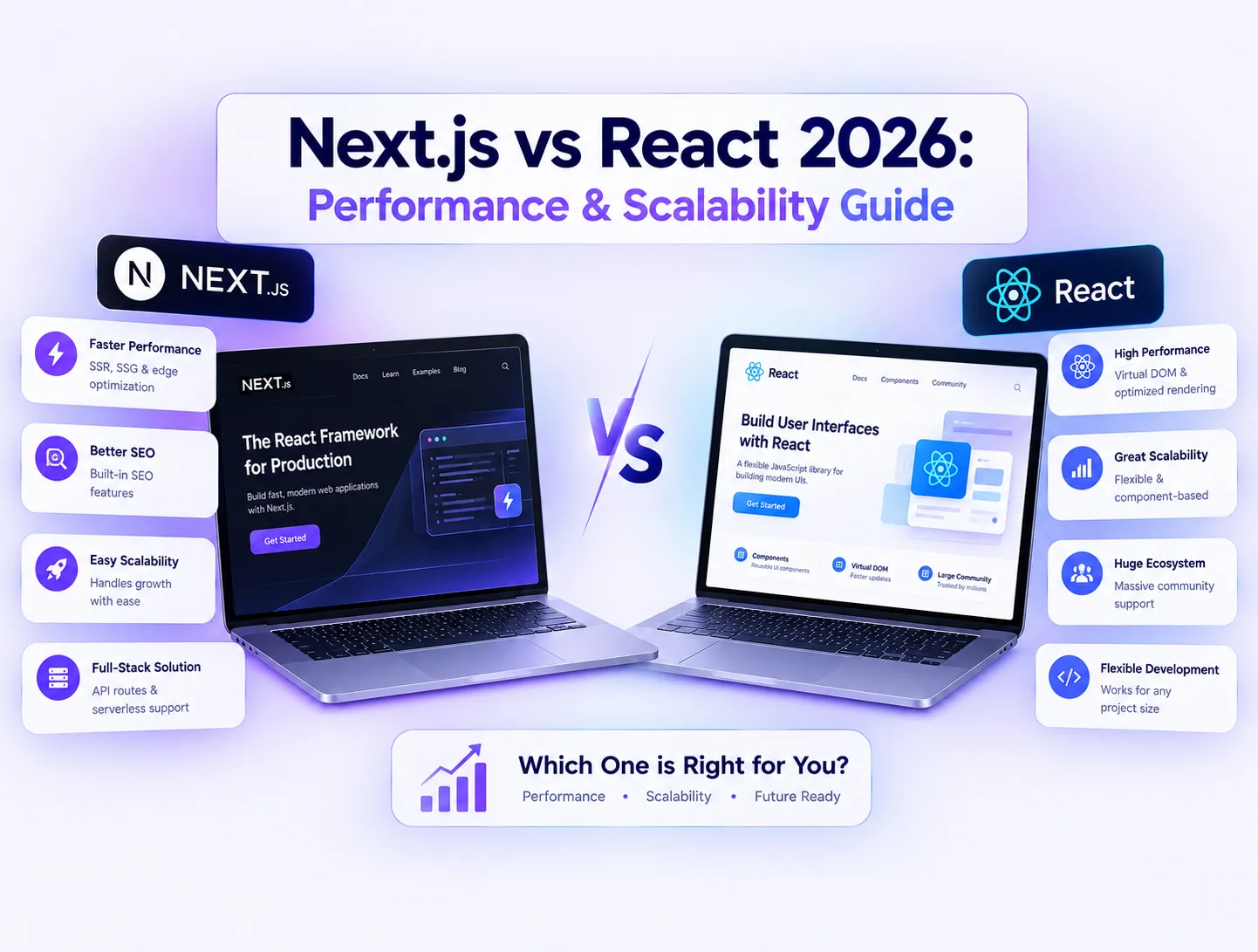
Next.js vs React 2026: Which Frontend Framework Wins for Scalability?
Choosing the right frontend technology stack is one of the most critical architecture decisions for enterprise software engineering teams, agency leads, and startup founders operating in 2026. As Google Search algorithms continuously prioritize page performance, core web vitals, and instant client interactivity, selecting between Next.js and React dictates your application's organic search visibility, user retention, and long-term engineering maintenance overhead. Organizations aiming to capture global search traffic require fast digital assets built with clean code and robust infrastructure, making professional custom website development essential for sustainable digital success across competitive online channels.
1. Architectural Foundation: React Library vs Next.js Framework
To evaluate these frontend systems accurately, developers must distinguish between a user interface library and a complete enterprise application framework. React is an open-source JavaScript library developed by Meta, focused exclusively on rendering modular UI components using a dynamic Virtual DOM tree. While React offers maximum flexibility for single-page applications, it deliberately leaves routing, bundler setup, server integration, and metadata handling to third-party packages. Next.js, created by Vercel, builds directly on React by providing an end-to-end production environment complete with file-system routing, automatic bundle optimization, serverless API endpoints, and hybrid rendering modes out of the box.
2. Client-Side Rendering Bottlenecks in Modern Web Applications
Standard client-side React applications rely on Client-Side Rendering (CSR), where the web server sends a skeletal HTML container alongside a heavy JavaScript application bundle. The client browser must download, parse, and execute this entire script file before users or search engine crawlers can view rendered page content. While CSR works smoothly for internal administrative dashboards and password-protected web software, it creates significant organic indexing friction, increases initial loading latency, and negatively impacts Google Core Web Vitals performance for public marketing pages and e-commerce websites.
3. Server-Side Rendering (SSR) for Instant Page Acceleration
Next.js solves client execution bottlenecks by offering native Server-Side Rendering (SSR), generating complete semantic HTML markup on the edge server for every incoming user request. Delivering fully populated markup straight to the browser ensures that search engine crawlers instantly parse headings, text copy, structured metadata, and internal navigation without waiting for client-side JavaScript execution. This server-first execution model reduces Time to First Byte (TTFB), improves initial layout stability, and provides search engine crawlers with readable content on every page request.
4. Static Site Generation (SSG) and Incremental Updates (ISR)
For content-rich platforms, documentation hubs, and high-volume corporate blogs, Next.js provides Static Site Generation (SSG) to pre-compile HTML pages during project build time. These immutable static pages deploy across global Content Delivery Networks (CDNs), serving cached assets in milliseconds to global users. Furthermore, Incremental Static Regeneration (ISR) empowers engineering teams to revalidate and update individual static pages in the background without re-compiling the entire web application, pairing edge static speed with dynamic database freshness.
5. React Server Components and Client JavaScript Reduction
Modern Next.js versions leverage React Server Components (RSC) to execute complex dependencies exclusively on the web server. By keeping heavy JavaScript packages on the server side, client browsers receive clean, minimal code bundles, leading to lower CPU usage and faster script evaluation on mobile devices. This server component paradigm directly resolves Interaction to Next Paint (INP) bottlenecks, ensuring web applications respond instantly to user taps, clicks, and scroll inputs across low-spec mobile hardware.
6. Core Web Vitals Compliance: LCP, INP, and CLS Benchmarks
Passing Google Core Web Vitals requires strict asset delivery optimizations, image compression, font handling, and non-blocking DOM interactions. Next.js natively handles these technical requirements through built-in image components that automatically serve WebP or AVIF formats based on browser support. Additionally, automated web font preloading and priority fetch hints eliminate Cumulative Layout Shift (CLS) issues, ensuring digital platforms achieve passing green scores on Google PageSpeed Insights benchmarks without extensive custom plugin configuration.
7. File-System Routing and Backend API Integration
Developer velocity and maintainability directly influence software scaling timelines and engineering costs. Standard React projects require developers to manual configure third-party routing systems like React Router, leading to inconsistent folder structures across teams. Next.js streamlines project organization through its intuitive App Router, where nested folder structures directly dictate public URL endpoints. Built-in API Route Handlers and Server Actions also allow developers to execute backend database queries and handle form submissions inside the framework.
Comprehensive Architectural Comparison Matrix
| Architectural Benchmark | Standard Client React (SPA) | Next.js Production Framework |
|---|---|---|
| Default Rendering Strategy | Client-Side Rendering (CSR) | Hybrid (SSR, SSG, ISR, RSC) |
| Initial Page Load Speed | Slower (Requires bundle download) | Instantaneous (Pre-rendered edge HTML) |
| Search Engine Indexability | Requires complex setup | Native out-of-the-box SEO optimization |
| Routing Mechanism | Third-party library configuration | Built-in file-system App Router |
| Backend / API Integration | Requires external server API | Built-in Serverless API Route Handlers |
| Image & Asset Optimization | Manual configuration required | Native automated Image/Font components |
| Core Web Vitals Compliance | Heavy manual optimization needed | Pre-configured performance defaults |
8. Long-Term Infrastructure and Hosting Ecosystems
Deploying client-side React single-page applications is straightforward, as compiled static files host easily on object storage buckets like Amazon S3 or Cloudflare Pages. However, enterprise Next.js applications utilize server-side execution, requiring Node.js runtime environments or serverless edge infrastructure such as Vercel, AWS Amplify, or custom Docker container clusters. While serverless hosting introduces minor infrastructure costs, the massive gains in organic search traffic, conversion rates, and global search visibility far outweigh server management expenses.
9. Strategic Selection: Choosing the Right Stack for Your Project
Selecting between raw React and Next.js depends entirely on your project's business goals, target user base, and search traffic strategy. Standard React remains an ideal option for building private SaaS portals, internal enterprise management systems, or interactive single-page tools where public search engine indexing plays no role in user acquisition. Conversely, Next.js is the gold standard for public e-commerce stores, international media outlets, and digital agency platforms that demand top organic search rankings, sub-second global response times, and maximum conversion performance.
10. Final Recommendations for Modern Web Architecture
As search engine algorithms continue to prioritize performance, technical engineering teams must choose frameworks that streamline code execution and maximize indexing speed. Implementing Next.js guarantees your platform stays ahead of web standards, delivering flawless user experiences that drive measurable business growth. Discover how Webnestech builds cutting-edge web platforms designed for speed, search visibility, and seamless international expansion.
Frequently Asked Questions
Essential technical questions regarding Next.js, React, performance optimization, and search engine visibility.
Next.js pre-renders HTML on the server via Server-Side Rendering (SSR) or Static Site Generation (SSG). This allows search engine crawlers to immediately parse fully rendered content without waiting for browser-side JavaScript bundle downloads.
Yes, Next.js provides serverless Route Handlers and Server Actions, enabling developers to connect to databases, authenticate users, handle payment webhooks, and process server-side logic without maintaining a standalone Node.js server.
Standard React is ideal for internal business portals, authenticated dashboards, interactive desktop-like browser applications, or projects where public search engine indexation and initial loading speed are not business priorities.
Next.js optimizes Core Web Vitals automatically through pre-rendered edge HTML delivery, native image optimization components that prevent cumulative layout shifts, automated web font loading, and server component execution.
Incremental Static Regeneration (ISR) allows developers to update specific static pages on demand or in the background after site deployment, combining the extreme speed of static hosting with the flexibility of dynamic rendering.
Ready to build high-performance web apps?
Our custom development team is here to scale your software platform.