
Introduction to Paid Search and Social Advertising
Choosing the right digital advertising channel is one of the most critical growth decisions for businesses, SaaS platforms, and digital service providers. Both Google Ads and Meta Ads (Facebook and Instagram) dominate the digital marketing landscape, yet they operate on fundamentally different targeting models. While Google Ads captures users with high commercial intent actively searching for solutions, Meta Ads excels at visual brand discovery, audience building, and proactive demand generation. Understanding the structural differences between search intent and demographic targeting allows businesses to allocate marketing budgets efficiently and maximize return on ad spend (ROAS).
Understanding Search Intent vs Demographic Targeting
The primary distinction between Google Ads and Meta Ads lies in user psychology and intent level at the moment an advertisement is served:
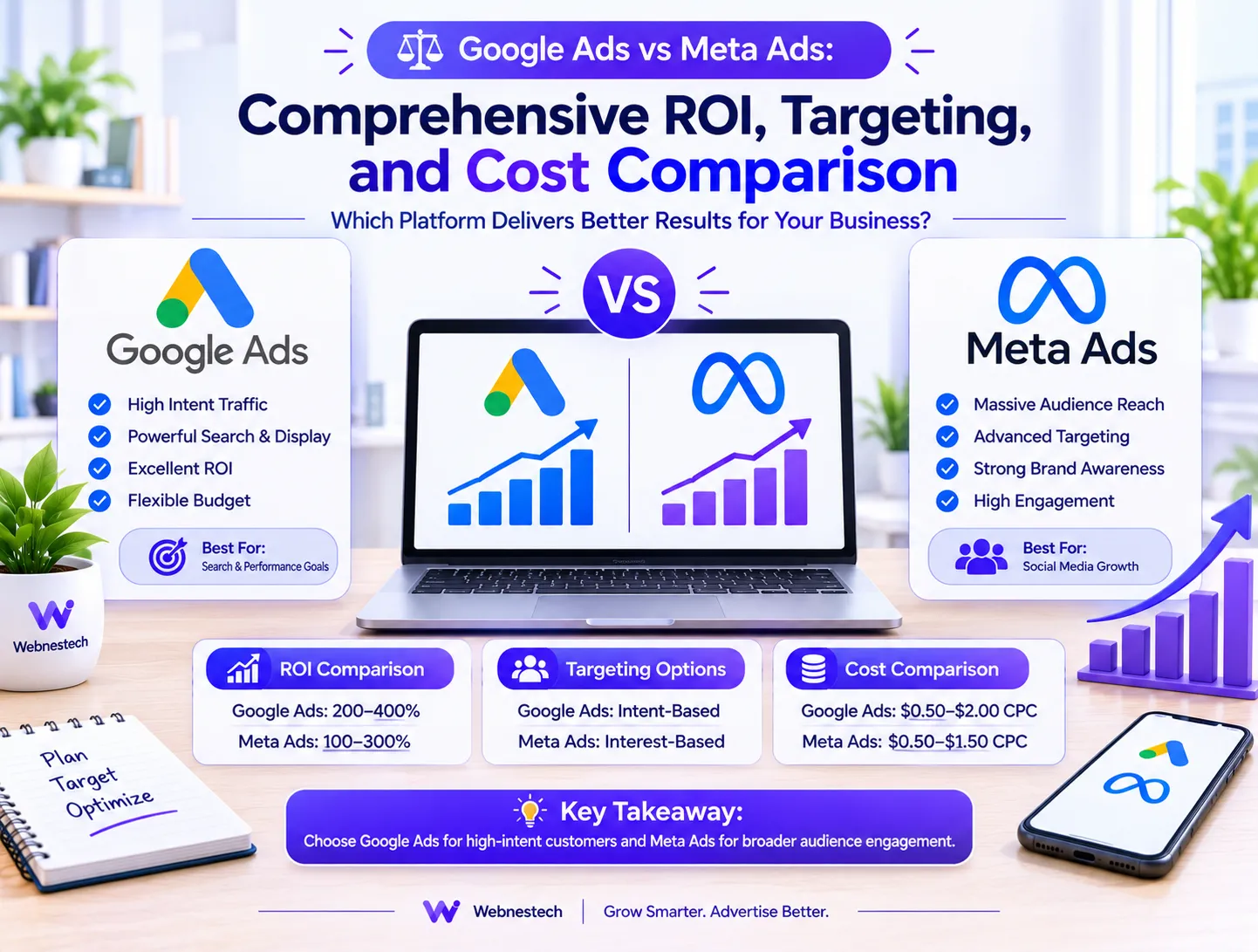
- Google Ads (Intent-Based Advertising): Captures active search demand. Users explicitly type queries into Google Search (e.g., "custom web application development" or "hire React developer"). Because the user is actively seeking a solution, conversion intent is extremely high, making paid search ideal for immediate lead capture and high-ticket service acquisition.
- Meta Ads (Interests & Demographic Targeting): Creates new demand. Meta places visual image, video, and carousel ads into users' Facebook and Instagram feeds based on interests, behaviors, age, job titles, and lookalike modeling. Users are not actively searching for a service, but highly targeted visual creatives capture attention and build brand awareness.
Key Ad Formats and Campaign Types
Both platforms offer distinct campaign structures tailored to different stages of the marketing funnel:
Google Ads Formats:
- Search Ads: Text-based ads appearing directly above organic search results for specific targeted keywords.
- Performance Max & Display Network: Multi-channel automated campaigns serving visual banner ads across millions of partner sites, YouTube, and Gmail.
- Google Shopping Ads: Visual product listings tailored for e-commerce platforms featuring direct pricing, images, and merchant ratings.
Meta Ads Formats:
- Feed & Stories Image/Video Ads: Full-screen immersive ad placements integrated seamlessly into Instagram and Facebook social feeds.
- Carousel & Collection Ads: Multi-slide visual galleries highlighting multiple features, products, or service portfolios in a single ad unit.
- Lead Generation Ads: Native lead forms that capture user contact information directly inside Meta platforms without requiring a external website redirect.
Digital Growth & Marketing Services
Scaling digital acquisition requires combining high-converting paid traffic with optimized web architecture. Exploring professional SEO services and performance engineering ensures your landing pages convert paid clicks into qualified sales opportunities with minimal friction.
Comprehensive Feature and Metric Comparison Matrix
The following table breaks down the core structural, cost, and operational differences between Google Ads and Meta Ads:
| Feature / Metric | Google Ads (Search & Display) | Meta Ads (Facebook & Instagram) |
|---|---|---|
| Primary User Intent | High commercial search intent (pull marketing) | Interest and passive discovery (push marketing) |
| Average Cost Per Click (CPC) | Higher ($2.00 – $15.00+ for competitive B2B/tech keywords) | Lower ($0.40 – $3.50 across most industries) |
| Targeting Strategy | Keywords, user search history, location, device type | Demographics, user interests, behavior, Lookalike Audiences |
| Creative Requirements | Minimal for search (text headlines, descriptions, extensions) | High visual creative dependency (graphics, video reels, copy) |
| Best For | High-intent leads, B2B services, emergency services, direct conversions | Brand awareness, e-commerce products, visual retargeting, lead magnet signups |
| Conversion Rate Expectation | Higher immediate lead conversion rate | Moderate direct conversion; requires retargeting funnels |
Cost Comparison and Budget Allocation Strategies
Budgeting for paid traffic depends on your business model, customer lifetime value (LTV), and sales cycle length. Google Ads typically commands a higher Cost Per Click (CPC) due to aggressive keyword bidding competition among advertisers targeting intent-driven search queries. However, because user intent is immediate, cost-per-acquisition (CPA) often balances out with higher conversion rates.
Conversely, Meta Ads yields lower CPCs and impression costs (CPM), making it cost-effective for testing visual messaging, running lead magnets, and retargeting site visitors. B2B software platforms and digital agencies often find maximum efficiency by combining both channels into a unified funnel: driving high-intent search traffic via Google Search Ads and retargeting non-converting visitors with visual case studies on Meta.
When to Choose Google Ads vs Meta Ads
To determine the optimal channel for your business, evaluate your current market positioning and budget scale:
- Choose Google Ads If: You offer a service or product that users explicitly search for daily, have a higher sales ticket size, and need high-intent leads who are ready to purchase immediately.
- Choose Meta Ads If: You are launching a novel product/service with low organic search volume, require heavy visual demonstration, or want to build brand awareness cost-effectively.
- Use a Hybrid Strategy If: You want to capture immediate search demand on Google while using Meta's custom audience tools to retarget visitors, build email lists, and drop customer acquisition costs over time.
Scaling Web Platforms and Marketing Funnels
Maximizing paid traffic efficiency requires lightning-fast landing pages, seamless user tracking, and continuous conversion optimization. Partnering with an expert development agency like Webnestech ensures your technical web application architecture, analytics integrations, and user interfaces are fully optimized to handle high-volume paid traffic campaigns.
Frequently Asked Questions
Key answers regarding campaign performance, ad spend allocation, targeting capabilities, and conversion metrics.
Neither platform is universally superior; Google Ads delivers higher ROI for high-intent search queries, while Meta Ads yields better ROI for visual products, retargeting, and brand awareness campaigns.
Google Ads generally has a higher average Cost Per Click (CPC) because advertisers bid on explicit purchase intent, whereas Meta Ads offers lower impression costs and cheaper initial clicks.
Yes. A multi-channel hybrid strategy where Google Ads captures cold search intent and Meta Ads handles social retargeting often yields the lowest overall Customer Acquisition Cost (CAC).
Google Search Ads is usually the primary choice for B2B tech companies because buyers actively search for specific service solutions, software keywords, and developer agency partners.
Landing page speed, mobile responsiveness, and clear value messaging directly impact conversion rates and lower AdSense/Google Quality Scores, reducing overall advertising costs.
Ready to optimize your acquisition channels and digital platform?
Partner with full-stack web engineering specialists to build fast, high-converting digital applications.