

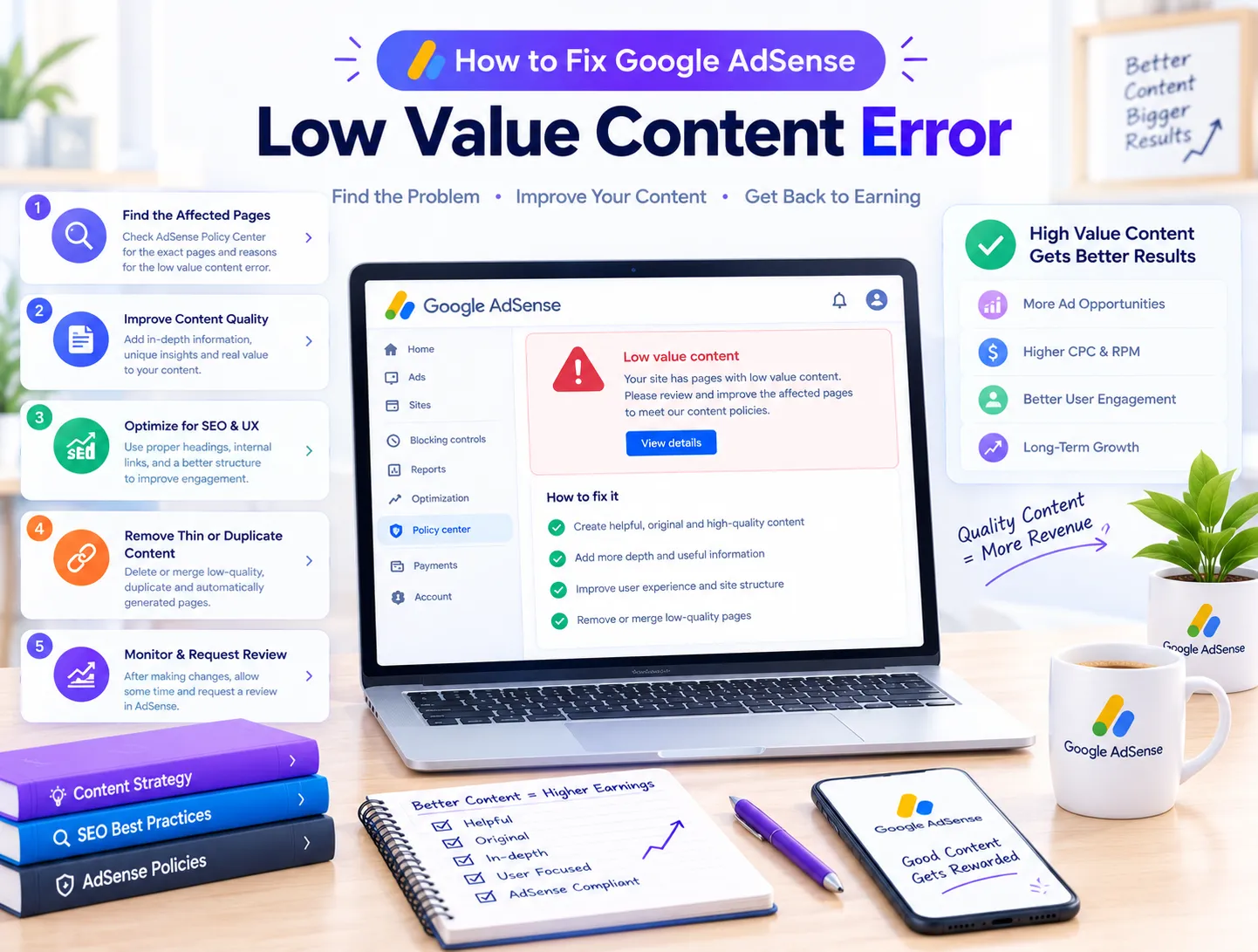
Understanding AdSense Low Value Content Warnings
Receiving an email notification from Google AdSense citing a "Low Value Content" rejection is one of the most frustrating experiences for website owners, publishers, and tool developers. However, this status is not a permanent domain ban. Instead, it serves as an automated quality flag indicating that your website currently fails to meet Google's strict publisher criteria regarding content depth, originality, or structural value. Understanding the official guidelines behind this error is the first step toward securing monetization approval.
Fix Google AdSense Low Value Content
To fix Google AdSense low value content violations, you must align your website with Google's core content expectations. The review system systematically evaluates whether a site offers meaningful insights, structured editorial depth, and a clean user experience. If your pages contain short summaries, replicated text, or bare utility tools without supporting written guidance, search crawlers automatically flag the domain as low value. Expanding shallow pages, resolving indexing gaps, and auditing your navigation hierarchy eliminates this barrier.
Official AdSense Program Policies and Requirements
Google enforces strict rules to ensure advertisers pay for placements on high-quality, engaging websites. The monetization review team relies on three foundational policy frameworks when auditing your domain:
- Google AdSense Program Policies: Outlines general compliance standards, invalid traffic rules, and page layout restrictions. Review the full criteria on the Official AdSense Program Policies Page.
- Google Publisher Policies: Defines prohibited content categories, restricted topic areas, and minimum content standards. Check details directly via the Official Google Publisher Policies Guide.
- Google Search Essentials (Spam Policies): Specifies quality standards regarding thin content, scraped text, and automated generation. Read the full documentation on Google Search Essentials Quality Guidelines.
Minimum Content Depth and Editorial Standards
One of the primary causes of a Low Value Content rejection is a lack of text-based substance. Google requires pages to contain sufficient original text so that search crawlers and ad algorithms can accurately understand the page context. If your website consists primarily of standalone calculators, simple converters, or short 200-word blurbs, you must expand each page into a comprehensive resource with detailed step-by-step instructions, use cases, and explanatory text.
Replicated Content and Originality Policy
Google’s publisher guidelines strictly penalize websites that publish replicated, scraped, or heavily paraphrased content. Automated AI generation without human editing often leads to generic phrasing that fails to offer new value over existing web results. To pass the AdSense audit, your articles must incorporate unique perspectives, original case studies, actionable troubleshooting steps, or original data points that cannot be found elsewhere.
Search Engine Optimization Strategy
Resolving technical indexing bottlenecks and structural policy violations requires a strategic approach to web performance. Implementing professional SEO services helps eliminate crawl budget waste, resolve indexation failures, and align your entire site structure with search engine quality benchmarks.
Site Navigation and User Experience Compliance
AdSense policy extends beyond body copy to encompass your overall site layout and navigation architecture. Websites featuring broken header links, empty category archives, missing legal disclaimers, or excessive template elements relative to actual body text are routinely flagged. Ensure your site features a clear navigation menu, working internal links, and easily accessible legal pages (Privacy Policy, Terms of Service, About Us, and Contact Us) in the footer.
Google Search Console Indexing Connection
There is a strong correlation between your Google Search Console (GSC) indexation health and your AdSense application outcome. If your XML sitemap submits 100 URLs but Google has only indexed 60 due to flags like "Crawled - currently not indexed," AdSense reviewers interpret the unindexed gap as low-quality filler. Pruning unindexed thin URLs and manually requesting indexing for high-value guides ensures Google evaluates a healthy, fully indexed domain.
Digital Growth Services
Scaling a modern web portal, SaaS tool platform, or digital agency requires pairing rigorous technical standards with expert design and execution. Partnering with a comprehensive growth agency like Webnestech ensures your technical architecture, user experience, and publisher standards are built for long-term commercial success.
Step-by-Step AdSense Re-Application Blueprint
Before resubmitting your domain inside the AdSense dashboard, execute this sequential compliance checklist to ensure your site passes review:
- Audit Page Depth: Ensure your domain features at least 15 to 20 fully developed, long-form articles (1,200+ words each) targeting clear user search intent.
- Fix Sitemap Gaps: Remove empty tags, draft pages, and low-utility parameters from your XML sitemap so only high-value URLs are submitted.
- Verify Essential Pages: Confirm that your footer contains active, working links to your Privacy Policy, Terms and Conditions, About, and Contact pages.
- Check Search Console Ratios: Verify in Search Console that at least 85% to 90% of your sitemap URLs are actively indexed before requesting a fresh AdSense review.
Maintaining Long-Term Monetization Compliance
Securing AdSense approval is an ongoing commitment to quality rather than a one-time task. Routinely auditing your site for broken links, updating decaying articles with fresh statistics, and maintaining strict editorial standards will keep your domain compliant, protect your ad serving status, and drive sustained organic traffic growth.
Frequently Asked Questions
Key answers regarding Google AdSense publisher policies, low value content errors, and re-application fixes.
AdSense flags low value content when site pages lack sufficient text depth, unique insights, original value, or proper structural navigation required for ad serving.
You can review official guidelines on the Google AdSense Program Policies and Publisher Policies support pages.
Yes, but tool pages must include comprehensive explanatory text, usage instructions, calculation formulas, and FAQ sections to satisfy content depth requirements.
If your sitemap has many unindexed pages, AdSense crawlers view those URLs as low quality, lowering your entire domain's evaluation score during site review.
There is no limit on re-applications. You can update your content, clean your indexable URLs, and resubmit through your AdSense dashboard whenever you are ready.
Ready to fix low value content errors and pass your AdSense review?
Work with expert strategists to optimize your technical architecture and editorial quality.