

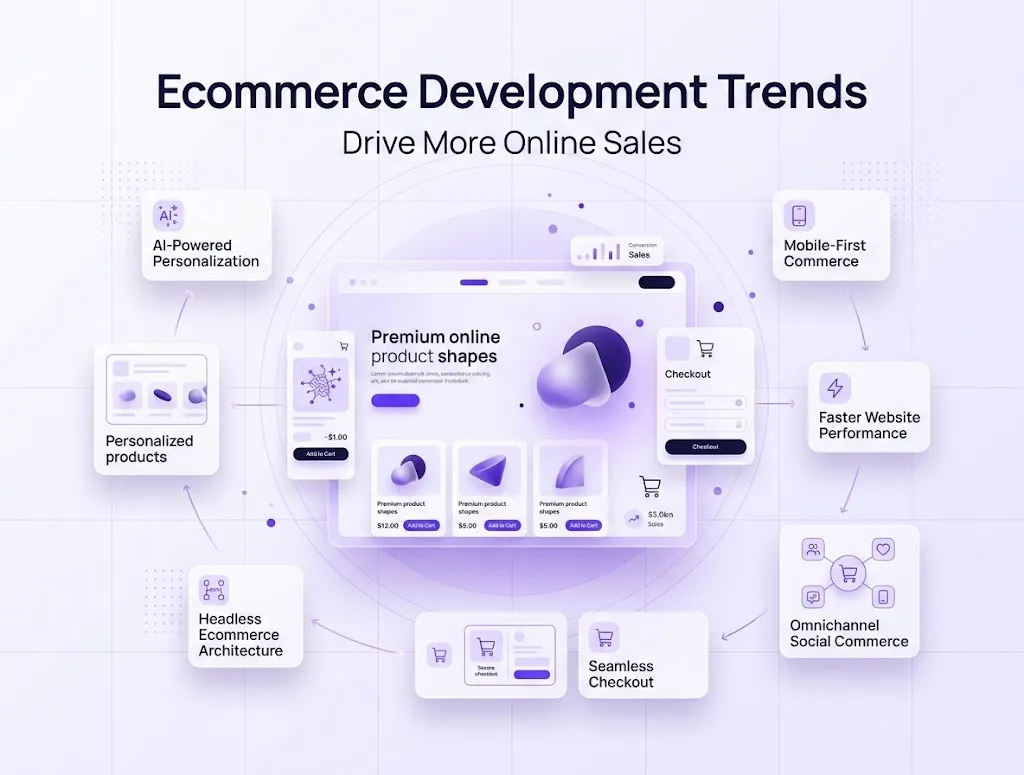
Ecommerce Development Trends That Can Drive More Online Sales
Modern customers expect a hassle-free, quick, safe, and personalized online shopping experience. Ecommerce trends focus on increasing revenue, and adapting to these trends is a necessity.
1. Mobile-First Ecommerce Development
Mobile shopping is growing rapidly, making mobile-first priorities essential for ecommerce development.
Make your ecommerce website convenient, appealing, informative, and fast for mobile users. Use large buttons and appropriately sized images.
A bad mobile experience can cause customers to abandon the website.
2. AI-Powered Personalization
AI analyzes customer behavior and provides personalized recommendations.
Recommendations can be based on previous purchases and products customers have viewed.
AI can also be used for product search, customer support, and marketing automation.
3. Faster Website Performance
Website performance directly affects the ecommerce experience.
Optimize images, remove unnecessary scripts, add caches, and use an appropriate architecture.
A fast website improves the user experience, reduces bounce rates, and simplifies the cart and checkout process.
4. Fast and Simplified Checkout Process
Abandoned carts cause lost revenue.
Request only the information that is needed and provide clear instructions.
- Guest checkout
- Multiple payment options
- Saved payment details
- Clear shipping costs
- Fewer checkout steps
5. Conversational Commerce and AI Chatbots
Customers often have questions about products.
AI chatbots can answer frequently asked questions, help customers locate products, and assist them in making purchasing decisions.
AI chatbots are not meant to replace humans but can deflect simple and frequent questions.
Live chat can be used for more complex cases.
Immediate responses may help improve conversion rates.
6. Voice Search and Smarter Product Search
Search is evolving.
Optimize for voice search and use natural language and related questions.
Autocomplete, filters, and misspelling correction can also improve the product search experience.
7. Social Commerce
Social media is becoming an important place for product interaction.
Social sharing, reviews, and social content can increase visibility and guide buyers.
8. Flexible and Secure Payment Options
Payment flexibility is significant for ecommerce.
Offer options such as cards, wallets, direct deposits, and other suitable payment methods.
An ecommerce site must keep customer data secure.
9. Augmented Reality
AR helps customers get closer to products, especially in industries such as fashion, furniture, cosmetics, and home appliances.
Both store owners and clients can benefit from augmented reality, and its use is expected to grow.
10. Headless Ecommerce and Flexible Technology
Headless ecommerce decouples the front end from the back end, providing greater flexibility.
The backend can be used across websites, mobile applications, social platforms, kiosks, and other touchpoints.
This approach is useful for businesses that need to scale, stay agile, and introduce new touchpoints. It can also reduce cost and effort compared with conventional approaches.
11. Better Customer Retention Through Personalization
Retaining existing customers is important.
Analyze user data to provide similar products, membership benefits, and personalized discounts.
Customer privacy must be protected.
Conclusion
Ecommerce is broader than having an appealing online store. Technology drives the customer journey, from product discovery to after-sales service.
Important trends include mobile commerce, personalization, website speed, convenience, chatbots, social commerce, flexible payments, augmented reality, and headless commerce.
Businesses do not need to adopt all trends immediately. Study customer needs and pain points first.
Successful ecommerce combines technological progress with a strong customer-oriented approach.