

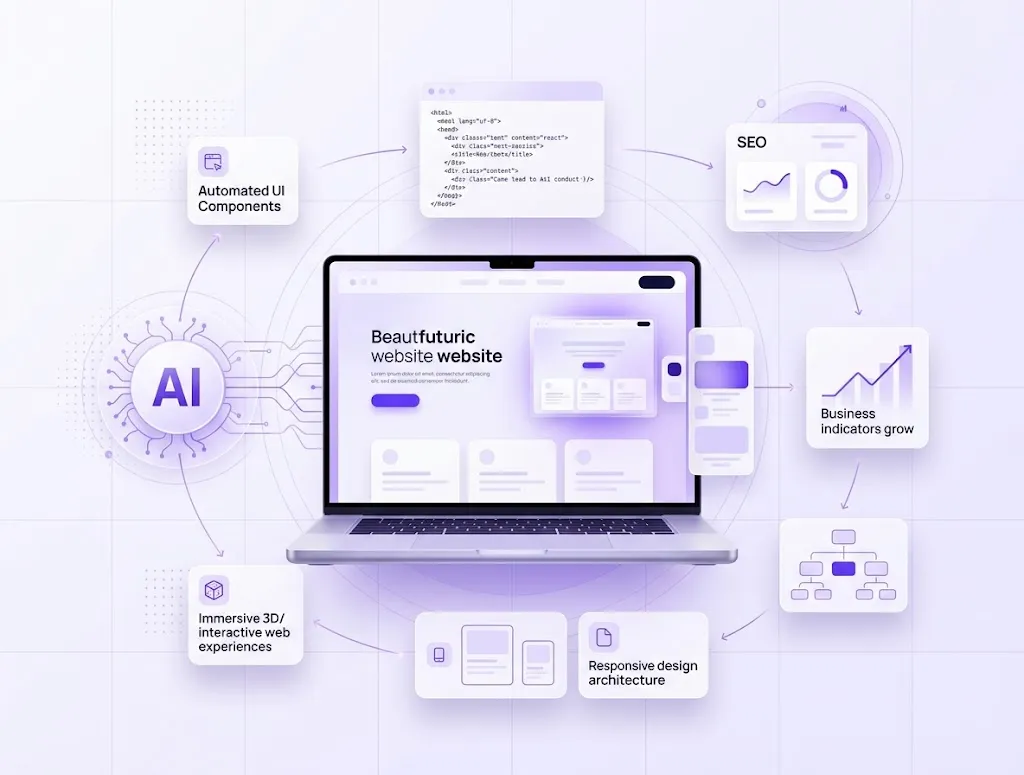
How AI Is Changing Website Development in 2026
The influence of AI on website development has never been like it. The impact of AI on website development in 2026 is unprecedented.
The process of website planning, design, development, testing and maintenance are being revolutionised with the use of AI. By 2026, AI will not only be able to generate a few lines of code, it will create complete architectural modules. It's becoming an essential part of the overall site development procedure.
The developers are leveraging AI to create the code, layout, detect bugs, write tests, optimize the performance and automate repetitive tasks. Recent industry research indicates that AI coding tools and agent-based development are also beginning to become a core part of a modern development workflow.
But Will It Take Web Developers Out of a Job?
Not exactly.
However, developers' roles are changing. AI is taking up less time for repetitive coding, allowing developers to focus more on architecture, problem solving, testing, security, and reviewing AI-generated solutions.
AI Is Speeding Up the Website Development Process
AI is accelerating website development dramatically.
AI is one of the most significant advantages as it executes implementation tasks very fast.
Some tasks can be done much quicker with the help of AI, whereas they used to take hours to finish. Developers can specify their desired functionality in natural language and get the code, components, database queries or styling suggestions as a result.
For instance, when a developer wants to build a contact form, they can request an AI coding assistant to generate an AI-driven contact form that is responsive, complete with validation and error message boxes.
The developer can then review, test, and modify the generated code to match project standards.
It is not a rule that all complex web systems can be built in one click. There is still a need for professional planning and engineering for enterprise projects.
AI can, however, reduce the amount of boilerplate and repetitive work in development to a great extent.
AI-Powered Website Builders
In 2026, AI website builders are gaining massive popularity.
A user can give a succinct briefing of a website and AI can create an initial draft of the website design, which includes layout, text, images, colours, and functional sections.
This is especially helpful when you're talking about:
- Small businesses
- Freelancers
- Startups
- Bloggers
- Agencies
- Entrepreneurs
The accessibility of web development is enhanced by AI website builders as users don't necessarily have to know advanced coding to build an initial digital presence.
However, human editing is still crucial. AI websites might need to be customized with improved branding, accessibility, SEO optimization, content depth, and unique functionality. Although AI building tools are improving, manual curation is essential for a professional corporate appearance.
AI Is Impacting Developers' Coding in Numerous Ways
Traditional software development required writing code line-by-line.
This process is being revolutionized with the assistance of Artificial Intelligence.
AI can provide a preliminary implementation while developers refine the feature. They can request the AI to explain errors, suggest structural optimizations, or write comprehensive unit tests.
This provides a much more streamlined and natural development lifecycle.
The developer's focus has shifted from typing out repetitive syntax to describing desired outcomes, architecting solutions, and evaluating code correctness.
AI coding agents are a relatively new phenomenon that has emerged in software engineering, where developers directly review changes, orchestrate AI agents, and maintain code quality.
The Website Design Industry Has Been Transformed by AI
The landscape of website design has been evolving rapidly due to artificial intelligence, improving UI/UX workflows across the board.
AI is revolutionizing the design phase by assisting creators with:
- Layout ideas
- Color combinations
- UI components
- Website sections
- Images
- Icons
- Typography suggestions
- Design variations
This allows creative teams to experiment with dozens of concepts within a fraction of the usual time.
AI provides inspirational recommendations to spark creativity, helping designers select the most appropriate aesthetic while saving substantial effort.
What's important to remember is that despite AI assistance, human branding and empathy remain irreplaceable.
A website cannot simply be a generic AI template; it must accurately reflect the brand identity, target audience, industry niche, and core mission of a business.
AI and Customized Websites
Personalized digital experiences represent another major breakthrough driven by AI.
Most traditional websites display the exact same static content to every single visitor.
AI significantly enhances website personalization dynamically.
For instance, an e-commerce platform can recommend bespoke products based on real-time browsing behavior and user preferences.
Travel websites can suggest customized destinations tailored to past user interests.
SaaS portals can dynamically alter landing page messaging depending on the visitor's industry sector.
This level of personalization makes websites vastly more useful, leading to higher engagement and conversion rates.
AI Chatbots Are Becoming More Intelligent
The capabilities of AI chatbots have evolved far beyond basic rule-based systems.
Modern AI assistants are transforming customer support interactions completely.
Older chatbots relied strictly on rigid pre-defined question-and-answer trees.
Today's intelligent AI assistants understand natural language nuances and handle complex conversational requests effortlessly.
Visitors can ask intricate queries and receive accurate, contextual responses instantly.
This shields enterprises from repetitive support inquiries while helping users locate information much faster.
AI Is Becoming a Part of SEO
Artificial intelligence is making a profound impact on search engine optimization (SEO) and content structuring.
AI assists developers and marketers in discovering:
- Keyword opportunities
- Content topics
- Internal linking opportunities
- Metadata optimization
- Technical crawl issues
- Content gaps
- Search intent alignment
However, AI should never be treated as a shortcut to bypass genuine SEO strategy.
Publishing hundreds of unedited, low-quality automated articles does not guarantee search engine rankings.
Search engines like Google prioritize helpful, expert, authoritative, and trustworthy (E-E-A-T) content.
AI should serve as an efficient assistant during research and drafting, rather than completely replacing human editorial oversight.
With the Help of AI, Website Testing Has Improved
AI is revolutionizing quality assurance and website testing.
Testing cycles that once took days can now be automated efficiently.
Developers use AI to generate extensive test cases and uncover hidden edge-case bugs.
AI can simulate rigorous form validation scenarios, such as:
- Entering incorrect data formats
- Leaving required fields empty
- Inputting special characters and scripts
- Submitting incomplete multi-step records
AI also provides developers with detailed diagnostic feedback on error logs and traceback origins.
This enables engineering teams to identify and resolve bugs early in development before deployment.
AI Is Helping Developers to Find Bugs
Debugging is traditionally one of the most time-consuming aspects of software engineering.
A developer could spend hours trying to trace why a script failure or rendering crash occurred.
AI inspects codebases, runtime context, and server logs to suggest root causes and rapid fixes.
While AI diagnostic suggestions require human verification, they act as an invaluable copilot in reducing troubleshooting time.
AI and Website Performance
As web applications become more intricate, maintaining top-tier performance and Core Web Vitals is paramount.
AI helps identify performance bottlenecks by analyzing code execution dynamics.
Optimization recommendations generated by AI include:
- Removing redundant JavaScript bundles
- Compressing and serving next-gen images
- Eliminating unused CSS rules
- Fine-tuning server caching strategies
- Optimizing slow database queries
- Managing resource load allocation
Slow websites harm user experience and search visibility. Ensuring fast, responsive, and machine-readable performance is critical in the era of AI-driven search.
AI and Website Security
While AI accelerates development, it introduces new security considerations.
Code generated by AI can occasionally contain vulnerabilities if not thoroughly vetted.
Human oversight remains non-negotiable for security compliance.
Industry research highlights that unverified AI code can introduce technical debt or security oversights if teams rely blindly on automation.
Developers must rigorously review AI code for:
- Security vulnerabilities
- Incorrect access permissions
- Data exposure risks
- Authentication flaws
- Unsafe third-party dependencies
- Improper error handling
Use AI to accelerate development, never to replace professional responsibility!
AI Coding Agents Have Come into Existence
Perhaps the most significant paradigm shift for 2026 is the transition from basic AI autocomplete tools to fully autonomous AI coding agents.
Instead of merely generating isolated snippets, AI coding agents can analyze entire code repositories, implement features, run test suites, interpret error logs, and iterate on bug fixes independently.
This alters the traditional engineering workflow:
Traditional: Developer writes code $\rightarrow$ tests code.
AI-Assisted (2026): Developer defines objective $\rightarrow$ collaborates with AI agent $\rightarrow$ reviews agent output $\rightarrow$ validates and deploys.
This evolution does not eliminate developers; rather, it elevates their role to system architects and quality overseers.
Will AI Take Over the Role of a Web Developer?
This remains one of the most frequently asked questions regarding technology and digital transformation.
While repetitive coding tasks are heavily automated, professional web developers are more vital than ever.
Core engineering disciplines requiring human expertise include:
- System architecture
- Cybersecurity compliance
- User experience design
- Business logic alignment
- Database modeling
- Scalability planning
- Performance tuning
- SEO engineering
- Accessibility standards (WCAG)
- Rigorous testing
AI proposes potential solutions, but human engineering judgment decides what gets deployed into production.
What Will Web Development Be Like in the Years Coming?
The future points towards deeper human-AI collaboration across all digital disciplines.
AI will absorb repetitive implementation tasks, leaving developers free to focus on high-level strategy and innovation.
While low-code AI tools make website creation accessible to non-technical founders, complex applications still require strict coding standards to prevent technical debt.
Enforcing rigorous testing protocols, security audits, and professional oversight is essential for sustainable digital growth.
Summary Comparison Table
| AI Integration Area | Traditional Approach | AI-Powered Approach (2026) |
|---|---|---|
| Code Generation | Manual line-by-line coding | Natural language prompts & AI assistants |
| Debugging & Testing | Manual log reviews & test case writing | Automated error tracing & test generation |
| Website Design | Static wireframing from scratch | AI layout variations & rapid UI components |
| Customer Interaction | Rule-based static FAQ chatbots | Context-aware intelligent AI assistants |
Final Thoughts
In 2026, artificial intelligence is fundamentally revolutionizing website building and software engineering.
It accelerates coding, simplifies testing, enhances personalization, empowers SEO, and makes complex development tools accessible to a wider audience.
Simultaneously, AI introduces new challenges regarding security, code quality, technical debt, and the necessity of human supervision.
The most successful developers and agencies in 2026 are not those who write the highest volume of syntax manually, but those who understand business requirements, system architecture, and how to leverage AI tools effectively.
Websites are no longer static brochures; they are intelligent, interactive digital ecosystems.
The powerful combination of human creativity, technical expertise, and AI orchestration forms the cornerstone of digital success. Businesses can strengthen their online presence with professional Webnestech services. If you're looking to build a modern website or improve your existing online experience, contact us to discuss your project and find the right solution for your business.
Frequently Asked Questions
A few things people usually ask about AI in web development.
No, AI automates repetitive coding tasks, but human oversight is essential for architecture, security review, business logic, and overall system quality.
Instead of manual line-by-line coding, developers now direct AI coding agents, review generated outputs, run automated tests, and handle final deployments.
AI builders create fast initial drafts and layouts, but human customization is required for unique branding, advanced accessibility, and SEO compliance.
Unchecked AI code can introduce vulnerabilities, incorrect permissions, or technical debt, making professional human code review and security audits critical.
Providing high-value, detailed, well-structured articles with comparative tables and FAQs satisfies search engine monetization and content quality expectations.
Looking to build a modern AI-powered website?
Our expert development team is ready to help you succeed.