

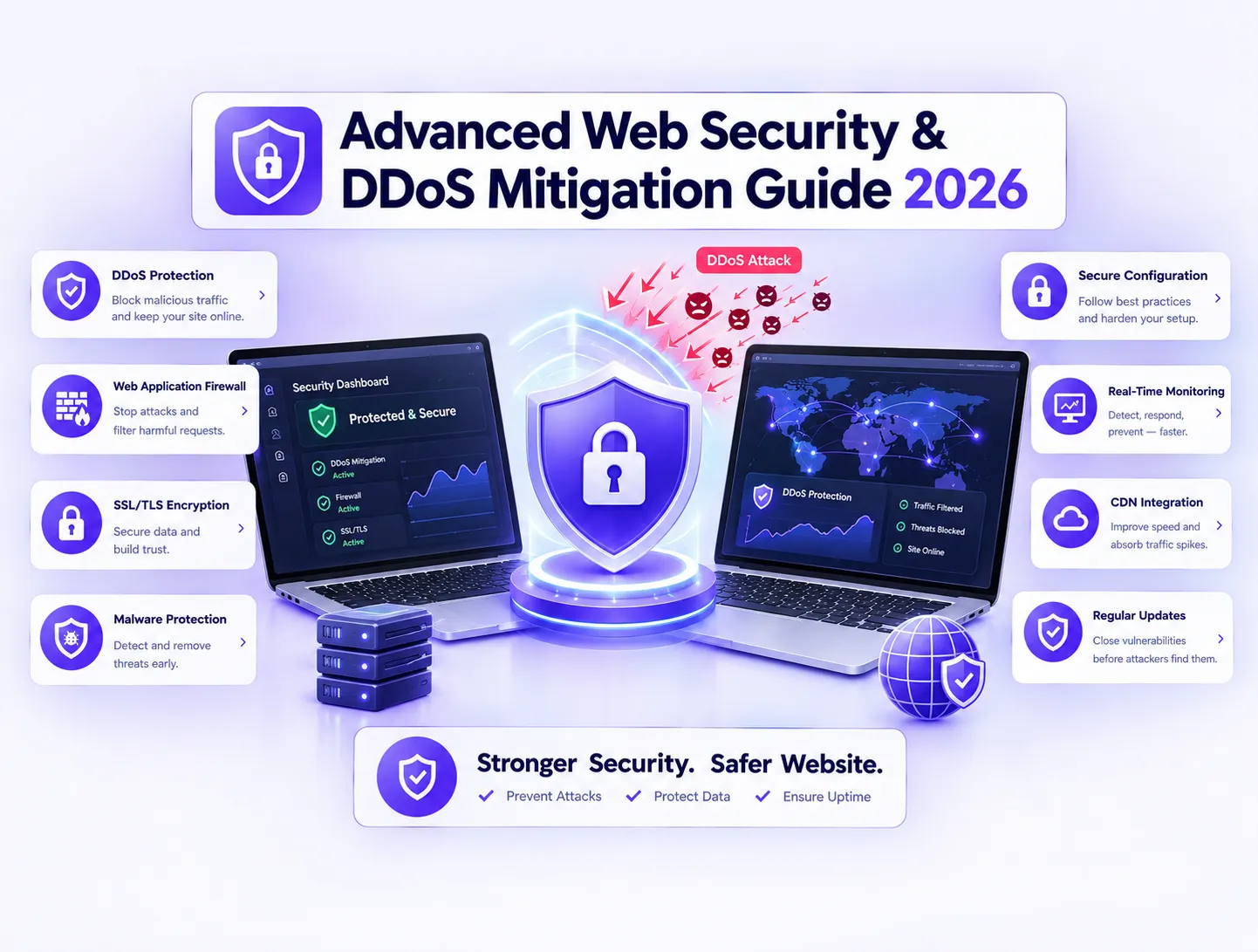
Advanced Web Security & DDoS Mitigation Blueprint
When I founded Webnestech, I made a strict commitment to our engineering teams that we would never build software that simply looks good on a staging server. The true test of any web platform is how resilient it remains when a malicious botnet targets your database or a volumetric Layer 7 flood attempts to crash your live infrastructure across our digital agency portfolio.

Real-time threat monitoring and behavioral traffic analysis are mandatory for modern high-traffic digital infrastructures.
1. The Escalating Reality of Modern Web Application Threats
Modern cyber adversaries have completely abandoned crude, easily detectable network attacks in favor of sophisticated, automated botnets designed to mimic human browsing behavior. Treating web security as an afterthought—such as relying on a basic SSL certificate and default server rules—exposes your business to sudden downtime, lost customer trust, and severe financial penalties.
Core Vulnerabilities Exploited in High-Traffic Platforms
- Layer 7 HTTP Floods: Malicious bot traffic overwhelming backend application logic and search APIs.
- Unsanitized SQL Injection Points: Open database queries exposing sensitive corporate and customer records.
- Cross-Site Scripting (XSS) Vectors: Unfiltered input fields allowing unauthorized client-side script execution.
- Broken Authentication Schemes: Weak JWT token expiration or unencrypted microservice communication.
- API Resource Exhaustion: Public endpoints lacking rate caps, enabling continuous data scraping.
2. Decoding Layer 7 Application-Layer DDoS Attacks
Unlike network-level floods that attempt to saturate internet bandwidth, Layer 7 attacks target your web server's CPU, memory, and database connection pools directly. By executing resource-intensive requests against login portals, checkout pages, or search filters, bad actors force your server to crash without needing massive packet volumes.
4 Steps to Neutralize Layer 7 Floods Before Reaching Your Server
- Deploy edge-based Web Application Firewalls (WAF) to inspect request payloads in real-time.
- Enforce cryptographic JavaScript challenge pages to verify human visitors at the CDN edge.
- Implement dynamic rate limiting tailored to specific high-cost application endpoints.
- Utilize heuristic traffic inspection to detect and block headless browser signatures automatically.
3. Hardening Backend Application Architecture and APIs
Building secure custom applications requires an uncompromising zero-trust mindset across every microservice, controller, and database interaction. Every piece of incoming client data must undergo rigorous server-side validation, ensuring that unauthenticated requests are intercepted long before they interact with internal database clusters.

Proactive code audits and vulnerability patch management protect enterprise web applications from zero-day exploits.
Essential Developer Checklist for Zero-Trust Application Security
- Parameterized Queries: Eliminate SQL injection risks by strictly enforcing prepared database statements.
- Strict CORS Policies: Restrict API access exclusively to verified, whitelisted client domains.
- Encrypted Payload Transmission: Mandate TLS 1.3 encryption across all internal microservice calls.
- OAuth 2.0 & JWT Verification: Require cryptographically signed authorization tokens for all API routes.
4. Balancing High-Level Security Hardening with Blazing Page Speeds
A common mistake among technical leaders is implementing security inspection layers that introduce heavy latency, destroying Core Web Vitals and user conversion rates. Offloading threat detection to global serverless edge networks ensures that malicious traffic is filtered instantly while genuine human visitors experience sub-second page load speeds.
Enterprise Web Security Threats and Mitigation Matrix
| Cyber Threat Vector | Primary Business Impact | Technical Root Cause | Engineered Defense Solution |
|---|---|---|---|
| Layer 7 HTTP Floods | Server CPU exhaustion & downtime | Simulated human botnets targeting dynamic routes | Edge WAF behavioral challenge pages |
| Advanced SQL Injection | Database breach & data theft | Unsanitized user parameters in SQL queries | Parameterized queries & schema validation |
| Cross-Site Scripting (XSS) | Session hijacking & credential theft | Unfiltered user-generated content rendering | Enforced Content Security Policy (CSP) headers |
| Automated API Scraping | Intellectual property loss & server strain | Unauthenticated public routes lacking rate caps | OAuth tokens & dynamic API rate limiting |
| Volumetric DDoS Floods | Complete network bandwidth saturation | Massive UDP/SYN packet bombardment | Anycast CDN scrubbing centers |
5. Protecting AdSense Revenue and Organic Rankings Through 100% Uptime
For digital publishers and web platforms, server downtime causes an immediate financial loss by halting display ad impressions and disrupting programmatic bidding algorithms. Maintaining unyielding 100% server uptime protects your Google AdSense viewability metrics and preserves top organic search rankings across global search engines.
Financial Benefits of Continuous Application Availability
- Sustained Ad Viewability: Keeps programmatic ad tags rendering consistently without delivery drops.
- Search Engine Authority: Prevents crawl errors and rank drops triggered by server timeout responses.
- Preserved Brand Trust: Maintains flawless customer experiences during high-volume sales campaigns.
- Lower Recovery Costs: Eliminates emergency server restoration fees and emergency developer retainers.

Redundant cloud server clusters and automated failover routing ensure absolute business continuity during attacks.
6. Building a Proactive Security Culture for Future Growth
Long-term business continuity demands moving away from reactive patch management toward continuous security engineering. Establishing redundant cloud failover clusters, automated vulnerability scanning, and routine penetration testing empowers your organization to scale with complete technical peace of mind.
Partner with Webnestech for Enterprise Security Engineering
Protecting your enterprise from evolving digital threats requires an experienced technical partner committed to clean code, robust server architecture, and uncompromised security standards. If you are ready to fortify your digital infrastructure against modern cyber attacks, feel free to get in touch with our engineering team today.
Frequently Asked Questions
Expert insights into advanced web security, DDoS mitigation, and enterprise application hardening.
Layer 7 attacks mimic genuine human traffic by sending valid HTTP requests to resource-heavy endpoints, tricking basic firewalls into processing them until servers crash.
WAFs inspect incoming HTTP payloads at the network edge, instantly blocking malicious signatures like SQL injections, cross-site scripting, and bot scrapers.
Not when properly engineered. Utilizing edge-based CDNs and optimized WAF rules offloads inspection overhead, securing applications while maintaining sub-second speeds.
Custom applications feature unique business logic and proprietary database architectures that require rigorous, expert security hardening during development.
We recommend automated vulnerability scans on a monthly basis, supplemented by comprehensive third-party penetration testing annually or prior to major updates.
Ready to bulletproof your custom web application against advanced cyber threats?
Partner with our expert engineering team to secure your enterprise infrastructure today.